
How to Search Cherokee County Court Records
The county points the public to two free systems for case lookups. The Court Clerk links its "Search Court Records" button to On Demand Court Records, known as ODCR, which the county also uses for online payments. The second system is the Oklahoma State Courts Network, or OSCN, the statewide judiciary docket portal. Both list Cherokee County District Court in their court menus. A name, a business name, or a case number is usually enough to begin.
ODCR tends to be the simpler starting point. The search form on ODCR lets you narrow by court, party name, case type, and case number. The screenshot below comes from the ODCR home page that the Court Clerk relies on for record searches.
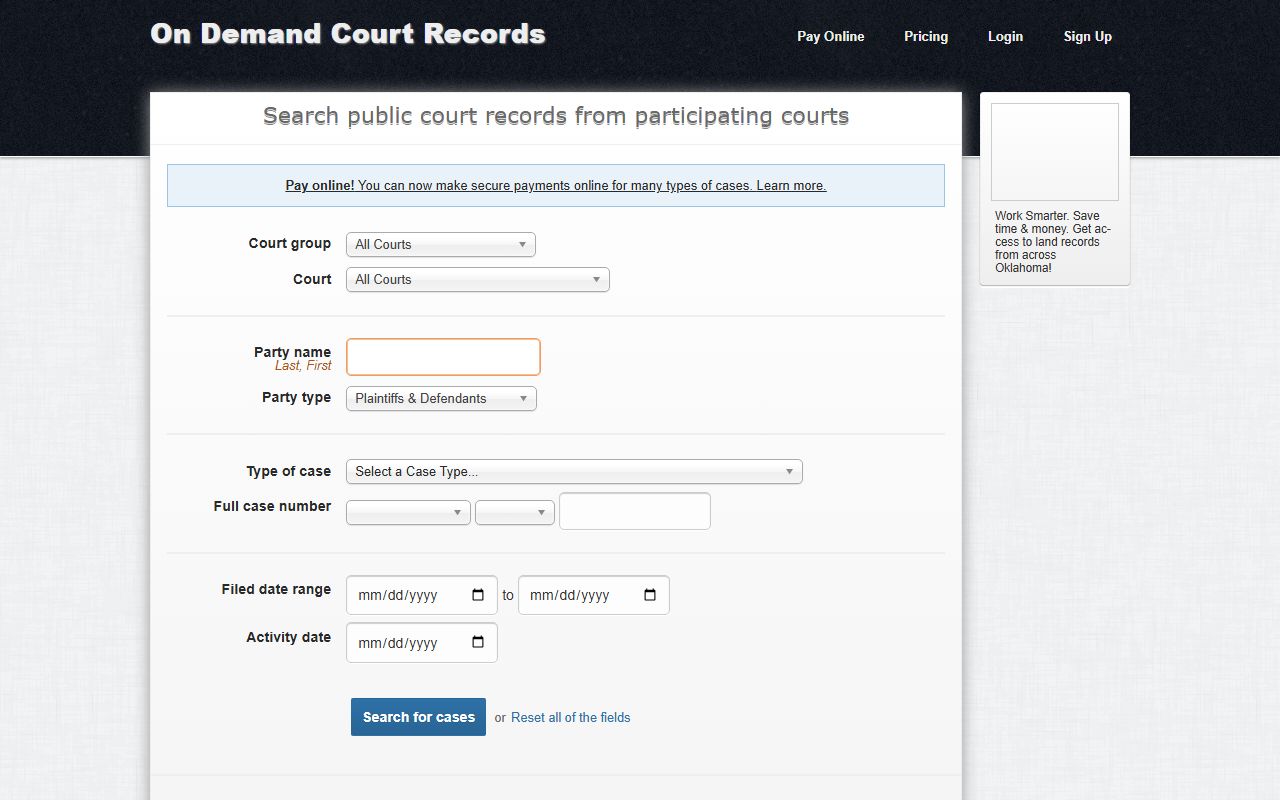
That form is the quickest way to confirm a Cherokee County case before traveling to the courthouse. Follow the steps below to run a clean ODCR search.
- Open ODCR and choose a court group. Use "Oklahoma District Courts" for state cases, or "Tribal Courts" for participating tribal courts.
- Select "Cherokee" from the court dropdown to reach Cherokee County District Court.
- Enter the party name in Last, First order, then pick "Plaintiffs & Defendants" or "All Parties."
- Narrow by case type if you know it, such as Traffic Tickets, Probate Proceedings, or Small Claims.
- Search by full case number when you have the prefix and year, then review the docket and order copies from the Court Clerk.
OSCN works as a strong backup. Open the OSCN docket search page, pick Cherokee County District Court in the case-number lookup, or pull a daily docket report by judge, case type, or event. OSCN may show a human-verification screen, so ODCR can be the practical first stop. Both systems carry the same case data the Court Clerk files.
The ODCR form fields are worth knowing before you start. The table below mirrors the live search screen.
| Field | Type | Notes |
|---|---|---|
| Court group | Dropdown | All Courts, Oklahoma District Courts, or Tribal Courts. |
| Court | Dropdown | Includes Cherokee and many other Oklahoma and tribal courts. |
| Party name | Text | Prompt asks for Last, First. |
| Party type | Radio | Plaintiffs & Defendants, or All Parties. |
| Type of case | Dropdown | Felony, misdemeanor, traffic, marriage, probate, small claims, and more. |
| Full case number | Compound | Prefix plus year and number, such as CF, TR, PB, ML. |
| Filed date range | Date range | Limits broad name searches. |
Note: Online dockets are convenient, but OSCN states the web page is not the official record and must be verified with the Court Clerk before it is relied on.
The Cherokee County Court System
Oklahoma runs a layered court system, and Cherokee County touches several levels of it. The Oklahoma Supreme Court is the final court for civil appeals. The Oklahoma Court of Criminal Appeals is the last word on criminal matters, and the Court of Civil Appeals handles many civil appeals in between. Below them sit the District Courts, the general trial courts where most cases start. Cherokee County is part of a northeastern Oklahoma judicial district that also includes nearby counties.
The Oklahoma Historical Society notes that the state organizes its District Courts into twenty-six judicial districts, and that litigation usually begins with a filing in one of them. Cherokee County District Court is that local trial venue. It hears felony, misdemeanor, traffic, wildlife, civil, family, small claims, protective order, probate, guardianship, mental health, juvenile, and adoption cases. Public access differs sharply by category, since some of those files are sealed by law.
Case flow: Municipal or District Court › Cherokee County District Court › Court of Civil Appeals or Court of Criminal Appeals › Oklahoma Supreme Court
| Court | Level | Case Types |
|---|---|---|
| Cherokee County District Court | Trial court | Criminal, civil, family, probate, traffic, small claims. |
| Tahlequah Municipal Court | Limited court | City ordinance cases and city traffic citations. |
| Cherokee Nation District Court | Tribal court | Tribal civil, criminal, and juvenile matters. |
| Court of Criminal Appeals | Appellate | Criminal appeals from the District Court. |
| Oklahoma Supreme Court | Appellate | Final court for civil appeals. |
Cherokee County Court Clerk Offices
Cherokee County splits clerk duties between two offices, and that split trips up many record searches. The Court Clerk, Lesa Rousey-Daniels, has run the court-records office since October 2018. Her office files civil, family, small claims, protective order, probate, criminal, and traffic cases. It also issues marriage, bondsman, and process-server licenses, holds wills for safekeeping, manages juries, and transmits appeals to the Oklahoma Supreme Court. For court cases, the Court Clerk in Room 302 is the office to call.
The County Clerk, Cheryl Trammel, keeps a different set of records in Room 200. That office records land instruments, deeds, mortgages, meeting notices, and county administrative files. Its land search runs through the OKCountyRecords vendor portal, which carries indexed data and images from April 1964 forward and adds new records in real time. The county page below introduces the County Clerk office and its contact details.
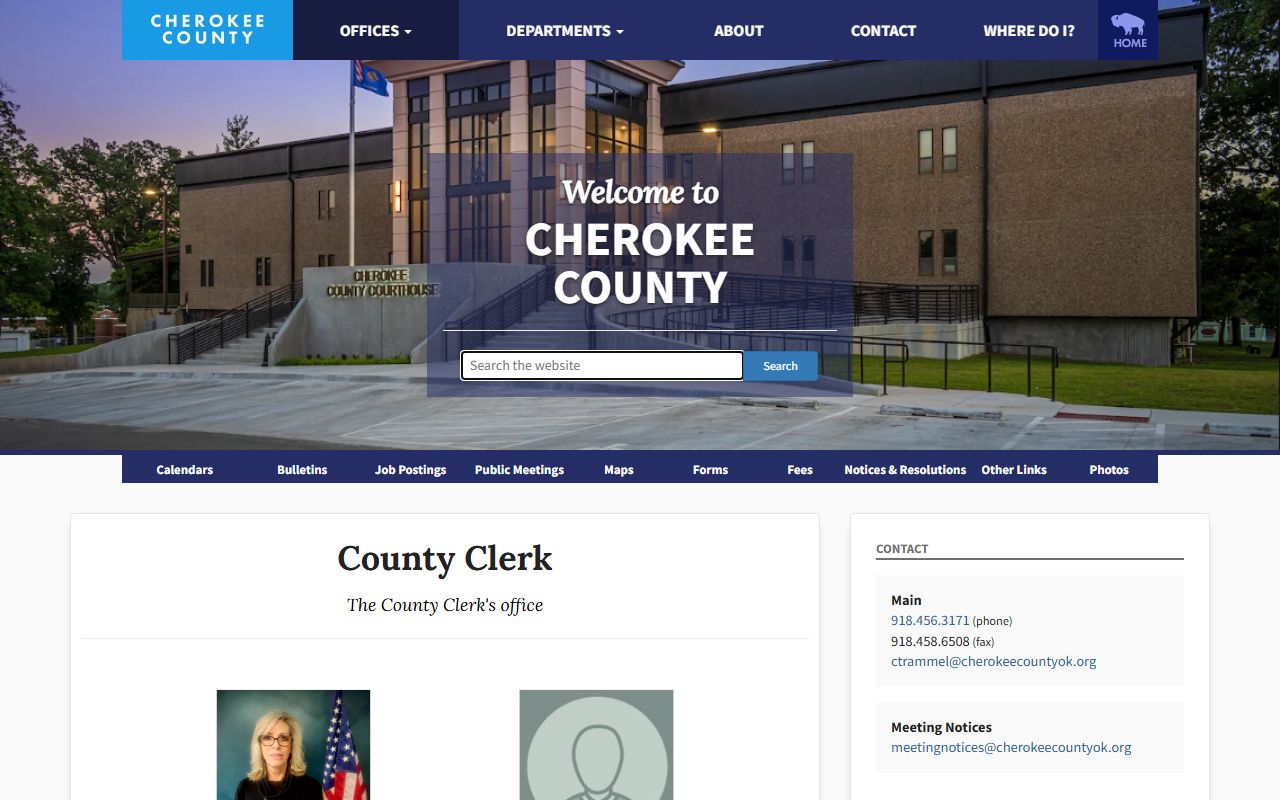
Knowing the difference saves a wasted trip across the hall. The comparison below sorts the two offices by what they hold.
| Feature | Court Clerk | County Clerk |
|---|---|---|
| Office | Room 302 | Room 200 |
| Holds | Court cases and dockets | Land and county records |
| Examples | Criminal, divorce, probate, traffic | Deeds, mortgages, liens |
| Search tool | ODCR and OSCN | OKCountyRecords |
| Phone | 918-456-0691 | 918-456-3171 |
Note: The County Clerk page warns that the Treasurer's mortgage certification fee rose to ten dollars on November 1, 2025, so confirm current land-record fees before filing.
Types of Court Records in Cherokee County
The Court Clerk files a wide span of case types, and each leaves its own record. Civil suits use the prefixes CJ, CS, and CV depending on the amount and the relief sought. Criminal files run from misdemeanors to felonies, with charges, pleas, dispositions, and sentencing entries. Family and divorce cases, marriage licenses, traffic citations, and wildlife actions all flow through the same office. The Court Clerk page below shows the full range of duties that office carries.
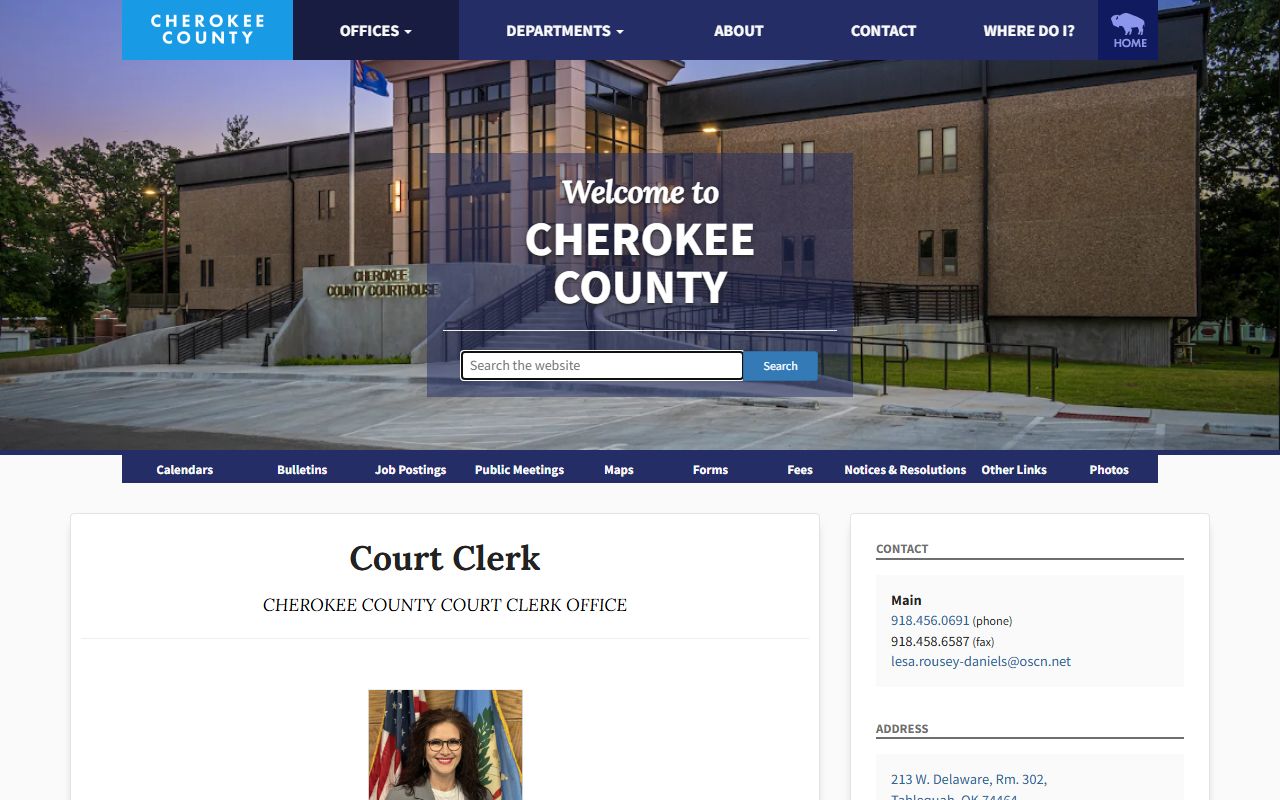
That office is the hub for nearly every state court file in the county. The main record groups break down like this.
- Criminal records - misdemeanor and felony files built with the District Attorney, holding charges, bonds, and outcomes.
- Civil records - petitions, answers, motions, judgments, garnishments, name changes, and foreclosures.
- Family and divorce records - decrees, waivers, paternity, and support filings held in District Court.
- Probate records - estates, wills for safekeeping, guardianships, and related orders.
- Traffic records - state citations and counts heard in the third-floor courtroom.
Some categories never reach public search. Adoption, guardianship, mental health, and juvenile files are filed with the Court Clerk but kept separate and closed to the general public. Land and recorded instruments belong to the County Clerk rather than the Court Clerk, so a deed search starts in a different office entirely.
What Cherokee County Court Records Show
A public Cherokee County docket follows a steady format. The header names the court as the District Court in and for Cherokee County, Oklahoma. Below it sit the case caption, the case number, the case type, the filed date, and the assigned judge. Then come the parties and their roles, any attorneys, the events, the counts, and a dated docket table. A sample traffic case, TR-2024-00345, shows each of these fields in a real public record.
That sample also shows the limits of online access. The OSCN docket page below carries the same warning that appears on every Cherokee County case it serves.
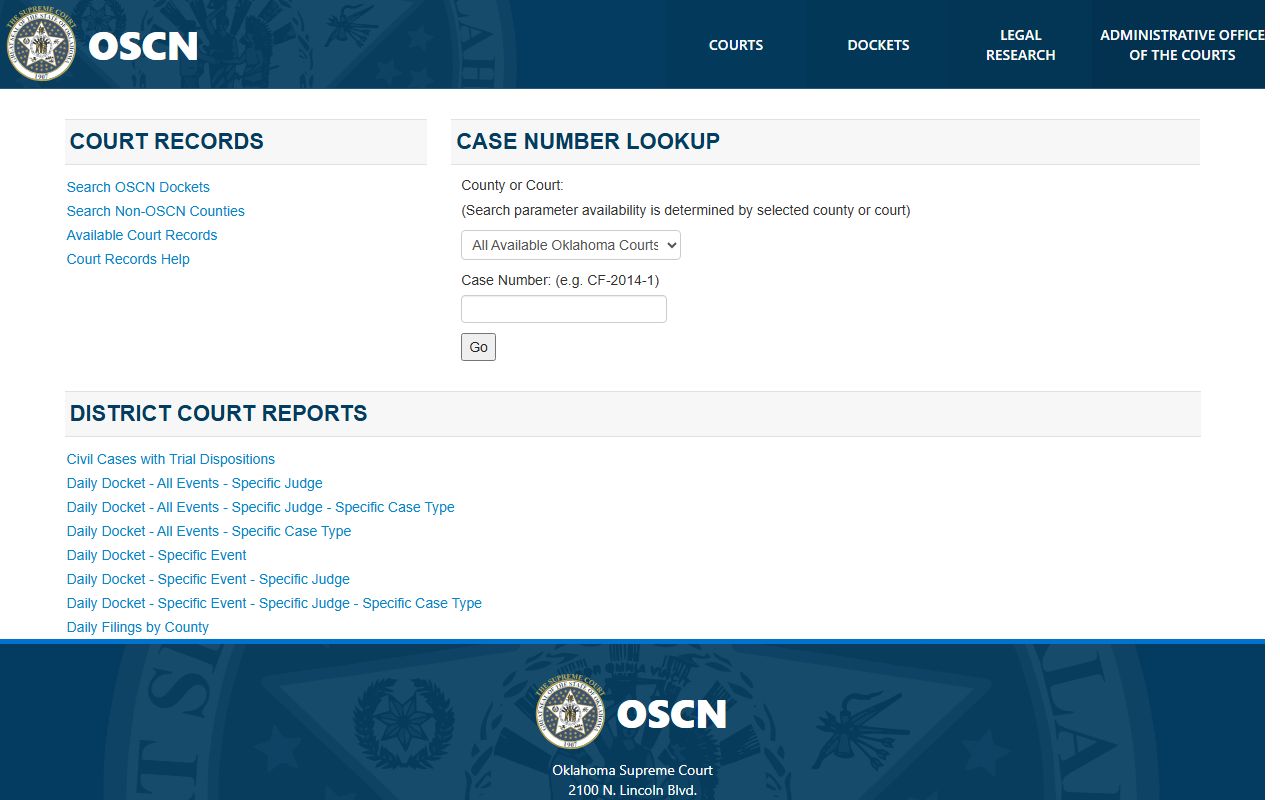
Reading the field table makes a raw docket far easier to follow. The columns below match the OSCN sample.
| Field | What It Shows |
|---|---|
| Case Number | Prefix, year, and number, such as TR-2024-00345. |
| Filing Date | Date the case opened with the Court Clerk. |
| Parties | Defendant, district attorney, arresting officer, and agency. |
| Counts | The charge or citation, such as "No Seat Belt - Driver." |
| Docket Table | Date, Code, Description, Count, Party, and Amount columns. |
| Disposition | Plea, payment plan, or warrant entry showing case status. |
Documents themselves often stay offline. The sample case marks filings as "Document Available at Court Clerk's Office" rather than offering a download, so the deepest detail still lives in Room 302.
Public Access Laws for Cherokee County Records
Oklahoma treats court records as open unless a statute closes them. The Oklahoma Open Records Act sets the baseline rule that records of public bodies stay open for inspection and copying during business hours. Court files add their own confidentiality layers for sensitive case types. The state library page below indexes the Open Records Act in full.
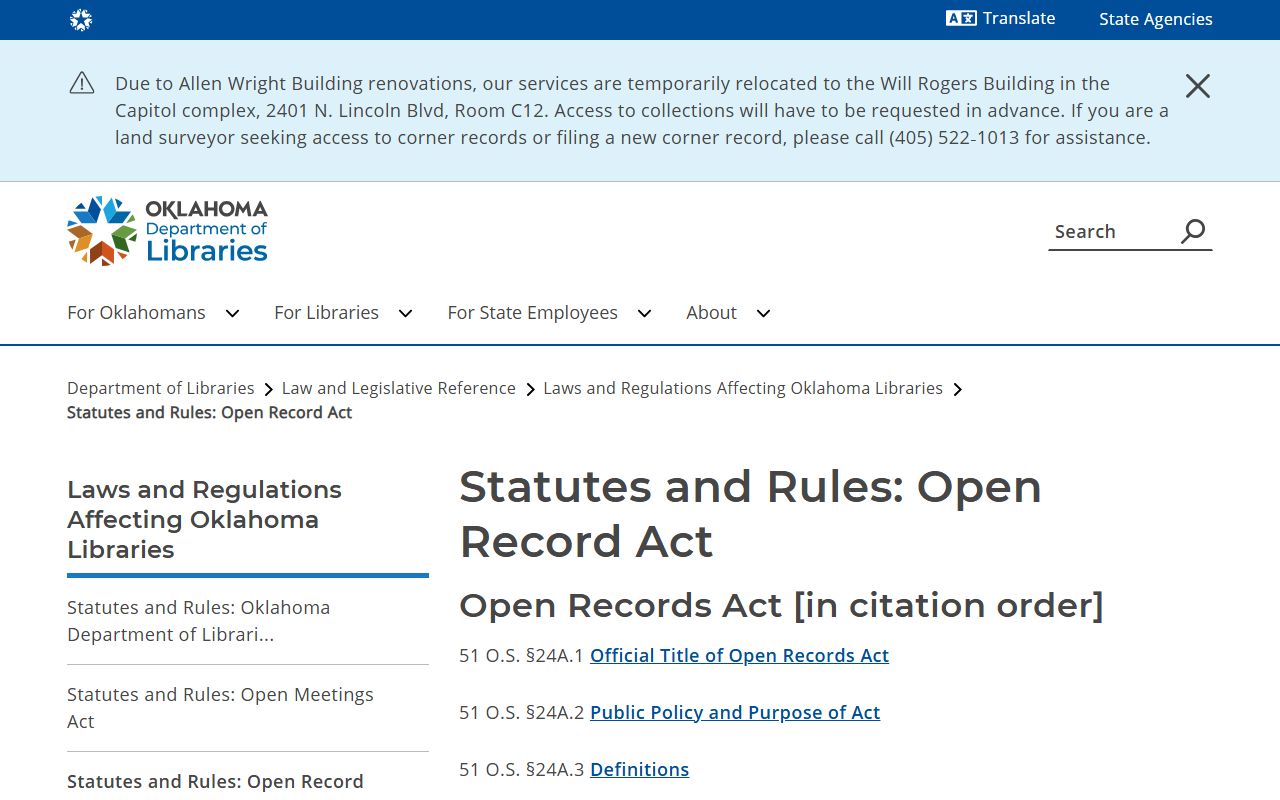
A handful of statutes do most of the work in Cherokee County. The key citations and their plain meaning sit in the box below.
Key Statutes:
51 O.S. §§ 24A.1-24A.33 - the Oklahoma Open Records Act, which keeps public records open unless a law makes them confidential.
22 O.S. § 18 - allows a full arrest record to be expunged or sealed when a person meets the statutory eligibility.
22 O.S. § 991(c) - updates a deferred sentence to show the case dismissed, but does not remove the arrest record.
Juvenile files sit outside this open framework. Under Oklahoma's 10A juvenile confidentiality provisions, juvenile court records stay closed except for authorized access. For everyday cases, the practical path is to search ODCR or OSCN, then verify the result with the Court Clerk, who keeps the official file.
Restricted and Confidential Court Records
Several Cherokee County case types are filed but never opened to the public. The Court Clerk states that adoption, guardianship, mental health, and juvenile matters are kept separate and closed. The probate page is even more specific. Guardianship files may be reviewed only by attorneys of record, the guardian, or the ward without a court order, and mental health records always require a court order.
Adoption records carry the tightest limits. The probate page says no adoption information is given over the telephone, and once a final decree is filed, access requires a court order. Before a decree, only the petitioners' attorney may review the file. Sealed and expunged criminal records follow their own track through the Oklahoma State Bureau of Investigation, which separates a full Section 18 arrest-record expungement from a Section 991(c) deferred-sentence update.
Clearing a Cherokee County record starts with identifying the right route. A person should decide whether the goal is to expunge the arrest record itself or only to update a deferred-sentence disposition. The petition is filed in District Court, notice goes to the prosecuting and record-holding agencies, and a granted order must reach repositories like the OSBI and the Court Clerk. Eligibility and fees are best confirmed with the Court Clerk and the OSBI.
Note: Because confidential files do not appear in ODCR or OSCN, a missing case does not always mean no case exists, so confirm closed categories directly with the Court Clerk.
Specialty Courts in Cherokee County
Oklahoma runs a statewide network of treatment-based courts, and Cherokee County connects to it. The state mental health department explains that adult drug court gives eligible non-violent felony offenders structured, court-supervised treatment instead of incarceration, and that the program has reached most of the state's counties. The clearest local contact found in official sources is the Adult Drug Court in Tahlequah, reachable at 918-207-0949 and listed alongside other courts in the judicial district. The District 27 District Attorney also lists a Drug Fund Payment option, which shows treatment-court fees are part of local case administration.
Tribal specialty courts add another local layer. In May 2026, the Cherokee Nation announced plans for a Mental Health Treatment Court built with a one million dollar federal award. The program is designed as a judicially supervised alternative to traditional sentencing for high-risk Native citizens with mental health and substance-abuse needs. The same announcement notes the Cherokee Nation already operates a Veterans' Treatment Court, a Juvenile Healing to Wellness Court, and a reentry program. Because Tahlequah is the Cherokee Nation capital, these programs matter for residents whose cases land in tribal court rather than state District Court.
Cherokee County Sheriff and Jail Records
The Cherokee County Sheriff is Jason Chennault, and his office covers roughly 776 square miles and about 49,000 residents. Duties include patrol in unincorporated areas, criminal investigation, courthouse security, prisoner transport, and civil process service for the District Court. The office runs around fifty employees and several K9 deputies. For warrant or civil-process questions, the sheriff's main line is the place to start.
One detail sets Cherokee County apart from most Oklahoma counties. The sheriff does not operate the jail. The Cherokee County Detention Center is a trust authority under a County Jail Board, a separate department within county government, and the sheriff sits on the board without running daily operations. That governance split matters when people call expecting the sheriff to hold roster details. For booking and custody questions, the full breakdown lives on the Cherokee County inmate records page, and active-warrant guidance sits on the warrant records page.
Cherokee County Traffic and Municipal Court
Not every Cherokee County ticket belongs in the same court. State citations are District Court traffic cases handled by the Court Clerk, while city citations route to Tahlequah Municipal Court. The split decides where you pay, where you appear, and where the record lives. The Court Clerk traffic page covers District Court tickets and explains the appearance and payment process.
District Court Traffic Court begins at 1:30 p.m. in the third-floor courtroom on scheduled dates at the Cherokee County Courthouse. A person may appear, or enter a plea on the back of the citation and mail the fine to Room 302 before the court date. Payment options include cash, cashier's check, money order, credit card, and ODCR online payment. Insurance citations carry a warning, since paying can trigger an automatic driver's license suspension by the Department of Public Safety, and proof of insurance may be presented to the District Attorney instead.
Tahlequah Municipal Court handles city ordinance and city traffic matters at 111 S. Cherokee Avenue. Payments can be made in person, by phone, or through Xpress Bill Pay, and the court publishes arraignment, trial, and fine schedules plus a 2026 Fresh Start Program. The municipal court states plainly that its mission is not to generate revenue but to improve public confidence in fair case resolution.
Marriage, Divorce, and Probate Records
The Court Clerk issues marriage licenses and keeps divorce and probate files. A license costs fifty dollars, or just five dollars with an original premarital counseling certificate, and no blood test or residency is required. Divorce cases are District Court records, and the office does not supply divorce forms. Probate runs through the District Court rather than a separate probate court, and the Court Clerk even stores wills for safekeeping. The marriage and divorce records and probate records pages cover each process in full.
Probate brings its own vocabulary, and a few terms recur across estate files. The definitions below cover the words that appear most often.
- Testator
- The person who made a will that the court is asked to admit.
- Executor
- The person named to carry out the terms of a will.
- Guardian
- A person appointed to manage the affairs of a ward who cannot act alone.
Confidentiality runs strong on the family side. Guardianship and adoption files stay closed, and mental health records require a court order, so a public ODCR search will not surface them. For older estate files or a will held for safekeeping, the Court Clerk in Room 302 is the direct contact.
Cherokee County Court Filing Fees
The Court Clerk publishes filing costs by case type, and the amounts shift with the kind of action and the dollar value at stake. Civil suits cost more as the claim grows, while name changes and relative guardianships sit at the lower end. Service costs are added on top of the base filing fee for many cases. The most useful published figures are gathered below.
| Filing | Fee |
|---|---|
| Divorce (with or without minor children) | $268.39 |
| Civil CJ, claim over $10,000 | $248.39 |
| Civil CS, claim under $10,000 | $235.39 |
| Civil CV, no monetary damages | $170.39 |
| Name change | $160.39 |
| Guardianship | $220.39 |
| Relative guardianship | $67.00 |
| Adoption | $184.14 |
| Sheriff service of process | $50.00 |
Court costs can be paid several ways. The Court Clerk accepts cash, cashier's check, money order, major credit cards, and online payment through ODCR, with checks payable to the Court Clerk and mailed to Room 302. Small claims add their own scale, with suits under five thousand dollars filing at fifty-eight dollars plus service. Because certified-copy charges are not published online, the Court Clerk is the office to call for current copy costs.
Reading Cherokee County Court Records
Docket language can look like code until the terms are clear. A count is a single charge or claim within a case, and a disposition is the current or final result of that count. A plea is the defendant's response, such as guilty, not guilty, or no contest. When a defendant misses a hearing, the docket often shows a bench warrant, sometimes written as BW, along with a bond amount. Knowing these terms turns a confusing entry into a readable timeline.
A short glossary covers the words that show up most across Cherokee County files.
- Plaintiff
- The person or entity that files a civil claim.
- Defendant
- The person accused in a criminal case or sued in a civil one.
- Bench warrant
- A warrant a judge issues, often after a failure to appear.
- Bond forfeiture
- Loss or risk against a posted bond after a missed court date.
- Continuance
- A postponement of a hearing or trial to a later date.
Charges are not the same as convictions. A filed count shows only what the District Attorney alleged, while the disposition shows how it ended. A case may be dismissed with prejudice, meaning it cannot be refiled, or without prejudice, meaning it may return. Reading both the counts and the disposition together gives the accurate picture.
Cherokee County Court History
Cherokee County was created at Oklahoma statehood in 1907, and Tahlequah has long been both the county seat and the capital of the Cherokee Nation. That overlap shapes local legal history. The Cherokee National Capitol and the old Cherokee National Penitentiary sit within the same downtown, and the Cherokee Nation Judicial Branch operates a District Court that serves all fourteen counties of the reservation with civil, criminal, and juvenile jurisdiction.
Jurisdiction in the county is unusually layered today. The U.S. Attorney for the Eastern District of Oklahoma describes the district as entirely Indian country, which affects how many offenses are routed among state, tribal, and federal courts. A case in Cherokee County may belong to the District Court, the Cherokee Nation District Court, or the federal court in Muskogee, so the right record keeper depends on the case. In May 2026, Chief Justice Dustin P. Rowe visited Cherokee County District Court, a sign of how closely the local court ties into statewide judicial administration.
Cherokee County Courthouse Contact
The Cherokee County Courthouse anchors downtown Tahlequah and houses the District Court counters. The Court Clerk works from Room 302 and the County Clerk from Room 200. Court Clerk hours run from 8:00 a.m. to 4:30 p.m. on weekdays. The contact card below gathers the main details for the court-records office.
Cherokee County Courthouse
213 West Delaware Street, Room 302
Tahlequah, OK 74464
918-456-0691
Accessibility requests have a named contact. ADA accommodations for the District Court are handled by Sherri Harmon, Judge Bailiff, at 918-456-8252 or sherri.harmon@oscn.net. Because the official county pages do not publish parking rates, transit routes, or security and screening rules, the safest step is to confirm parking and entry policy with the Court Clerk before a hearing or filing visit.
Frequently Asked Questions
How do I search Cherokee County court cases online?
Use ODCR or OSCN. On ODCR, choose Cherokee from the court list, enter a name in Last, First order, and narrow by case type or case number. OSCN offers the same Cherokee County District Court records and daily docket reports. Both are free. Each site warns that the online page is not the official record, so confirm anything important with the Court Clerk in Room 302.
What is the difference between the Court Clerk and the County Clerk?
The Court Clerk keeps court cases, including criminal, civil, family, probate, and traffic files, and works from Room 302. The County Clerk keeps land and county records such as deeds and mortgages, and works from Room 200. A case lookup goes to the Court Clerk, while a deed or land search goes to the County Clerk through the OKCountyRecords portal.
Are all Cherokee County court records public?
No. Most criminal, civil, traffic, and probate dockets are public, but adoption, guardianship, mental health, and juvenile files are kept separate and closed. Mental health records require a court order, and adoption records require an order once a decree is final. If a case does not appear online, it may be confidential rather than missing.
Does the Cherokee County Sheriff run the jail?
No. The sheriff sits on the board that oversees the jail but does not run daily operations. The Cherokee County Detention Center is a trust authority under a County Jail Board and is its own department. For custody questions, contact the detention center, and for warrant or civil-process matters, contact the sheriff's main line.
Where do I pay a Cherokee County traffic ticket?
It depends on the citation. State tickets are District Court cases paid to the Court Clerk by mail, in person, or through ODCR, with traffic court at 1:30 p.m. on scheduled dates. City tickets go to Tahlequah Municipal Court, payable in person, by phone, or through Xpress Bill Pay. Check the citation for the court name and date.
How much does it cost to file for divorce in Cherokee County?
A divorce filing costs $268.39 whether or not there are minor children. Service costs are added on top, such as fifty dollars for sheriff service or ten dollars for certified mail. The Court Clerk does not provide divorce forms, so those come from an attorney or a paralegal service. Payment may be made by cash, card, money order, or ODCR.
Can I clear or expunge a Cherokee County criminal record?
Possibly. Oklahoma allows a full arrest-record expungement under Section 18 when eligibility is met, and a Section 991(c) update for a deferred sentence that changes the disposition without removing the arrest. The petition is filed in District Court. Confirm eligibility and current fees with the Court Clerk and the Oklahoma State Bureau of Investigation before filing.