
How a Cherokee County Warrant Search Works
Cherokee County official pages do not publish an active-warrant search or a most-wanted list. There is no county portal where you type a name and pull a live warrant. The warrants still exist. They are created through court cases, and their trail appears inside those case files. The Court Clerk works closely with the District Attorney to file misdemeanors, felonies, traffic, and wildlife actions and to issue criminal warrants.
Because there is no single warrant page, the realistic Cherokee County warrant search is a short fallback chain. Search open court dockets first, then confirm status with the office that holds the record. The online docket tools run by the state show warrant-related entries in public criminal and traffic cases. After that, the Court Clerk and the sheriff can speak to whether a warrant is still active. No public statewide Oklahoma active-warrant database was located in official sources, so the court file remains the best starting point.
The order that follows reflects how the county is actually set up. Begin with the docket search, verify with the Court Clerk, then reach the sheriff, District Attorney, municipal court, or tribal court depending on where the case lives.
- Search ODCR or OSCN dockets by name and the Cherokee County court for warrant-related entries.
- Confirm any result with the Court Clerk at 918-456-0691, since online dockets are not official records.
- Call the Sheriff's Office at 918-456-2583 for law-enforcement or civil-process warrant questions.
- Route charge and prosecution questions to the District 27 District Attorney at 918-456-6173.
- For a city citation, contact Tahlequah Municipal Court at 918-456-9472.
Types of Warrants in Cherokee County
Warrants in Cherokee County come from judges and the court process. A judge signs the order, the court file records it, and law enforcement carries it out. The most common type tied to court records is the bench warrant, which a judge issues after someone misses a court date or fails to follow a court order. The state docket samples for Cherokee County show this kind of entry plainly.
- Arrest warrant - Issued when there is probable cause to believe a person committed a crime, often at the start of a criminal case.
- Bench warrant - Ordered by a judge after a failure to appear or a missed obligation, including unpaid court costs.
- Search warrant - Authorizes a search of a place or property; in court searches these carry the SW case prefix.
- Capias or failure-to-appear warrant - A court order to bring a person before the judge, frequently after a skipped traffic or criminal setting.
The Cherokee County traffic sample on the state docket system uses the shorthand "BW" and "B/F bond" after a defendant fails to appear, with a bond amount set once the warrant issues. That language is the practical fingerprint of a bench warrant inside an everyday case.
How to Search Cherokee County Warrant Records
Two free state docket tools cover the Cherokee County District Court. The first is ODCR, the On Demand Court Records portal the Court Clerk links for searching court records and paying costs. The second is OSCN, the Oklahoma State Courts Network docket site. Neither is a warrant list. Both let you open a case and read the docket for warrant entries such as a bench warrant, a failure to appear, a bond forfeiture, or a warrant that was recalled or quashed.
ODCR is the easier daily tool because OSCN may show a human-verification screen. Use ODCR to find the case, then cross-check on OSCN if you want a second view.
- Open the ODCR search form and set the court group to Oklahoma District Courts, then choose Cherokee for the court.
- Enter the party name in Last, First format, or enter a full case number when you know the prefix and year.
- Open the matching case and read the docket for warrant codes, bond amounts, recall or quash notes, and the next court date.
For a criminal matter, the full case file and any sentence sit in the Cherokee County criminal court records, which is where bench-warrant and bond entries are read alongside the charges. The docket warning still applies. Online pages are convenient, not official.
Cherokee County Warrant Search Fields
The ODCR form is built for case lookups, and the same fields work when you are hunting for warrant activity. The court field narrows you to Cherokee County, the name field finds the person, and the case-type and case-number fields let you target warrant-bearing matters such as Search Warrants or criminal and traffic cases. The table below lists the fields and how they apply to a warrant lookup.
| Field Label | Type | Required | Notes |
|---|---|---|---|
| Court group | Dropdown | No | Choose Oklahoma District Courts for state cases, or Tribal Courts for participating tribal courts. |
| Court | Dropdown | No | Select Cherokee for Cherokee County District Court. |
| Party name | Text | No | Enter Last, First. The most common way to find a person's warrant entries. |
| Party type | Radio | No | Plaintiffs and Defendants, or All Parties. |
| Type of case | Dropdown | No | Includes Search Warrants, Criminal Felony, Criminal Misdemeanor, and Traffic Tickets. |
| Full case number | Compound | No | Prefixes include SW search warrant, CF felony, CM misdemeanor, and TR traffic. |
| Filed date range | Date range | No | Narrows a broad name search to a window. |
| Activity date | Date | No | Filters by recent docket activity. |
Note: A name match alone does not confirm an active warrant, so always read the full docket and verify the status with the Court Clerk before acting on a result.
What a Cherokee County Warrant Record Shows
A warrant that appears inside a public Cherokee County case does not show up as a downloadable warrant document online. Instead, the docket reveals the facts around it. The state traffic sample for Cherokee County shows how this looks, with the file-and-enter citation entry, the failure-to-appear note, the bench-warrant shorthand, and the bond amount all sitting in the docket table. The fields below are what you can expect to read when a warrant is reflected in a public case.
| Field | What It Shows |
|---|---|
| Issuing court | The District Court in and for Cherokee County, or another court that ordered the warrant. |
| Case number | The prefix-year-number identifier, such as a TR traffic or CF felony case. |
| Charge or citation | The count description, for example a traffic citation or a criminal count. |
| Failure-to-appear event | The missed court date that triggered the bench warrant. |
| Bond amount | The dollar figure set after the warrant or bond forfeiture. |
| Recall or quash status | Whether the warrant was later recalled, quashed, or remains active. |
| Arresting agency | The agency tied to the underlying case, such as a sheriff's deputy or the highway patrol. |
| Court date | The next scheduled setting or the date tied to resolving the warrant. |
The same docket also tracks what happens after a warrant. Once a person appears or pays, the file can show a plea, a payment plan, or a sentence, and the warrant entry is followed by a recall. The public page states it is not the official record, so the Court Clerk remains the office that confirms the live status.
Who to Contact About a Cherokee County Warrant
Different offices answer different Cherokee County warrant questions, and reaching the right one saves time. The Court Clerk holds the official case file and can confirm whether a warrant is recalled, active, or tied to a payment plan. The Sheriff's Office handles law enforcement, courthouse security, prisoner transports, and civil process, so it fields questions about service and arrests. The District Attorney drives charges and prosecution. Keep in mind a local quirk noted on the county's own pages: the Cherokee County Sheriff sits on the jail board but does not run the detention center day to day.
Cherokee County Court Clerk
Lesa Rousey-Daniels
213 W. Delaware, Room 302
Tahlequah, OK 74464
918-456-0691
Hours: 8:00 a.m. to 4:30 p.m.
Cherokee County Sheriff's Office
Sheriff Jason Chennault
912 South College Avenue
Tahlequah, OK 74464
918-456-2583
For charge and case-filing questions, the District 27 District Attorney serves Cherokee County and can be reached at 918-456-6173. If a warrant connects to someone already booked, the Cherokee County inmate records page explains how custody status is confirmed through the detention center, the state offender lookup, and VINE notifications.
Municipal and Tribal Warrants in Tahlequah
Not every warrant in Tahlequah belongs to the District Court. City citations and ordinance cases run through Tahlequah Municipal Court, which handles its own arraignment and trial schedules, a fine schedule, and payment options. A missed city court date or an unpaid municipal fine can produce a city bench warrant that the District Court docket will not show. The municipal court also lists a 2026 Fresh Start Program that may bear on old fines or warrants.
The Tahlequah Municipal Court page lists its hours, judge, payment methods, and clerk contacts and is the place to start for a city ticket. You can review it directly through the Tahlequah Municipal Court page.
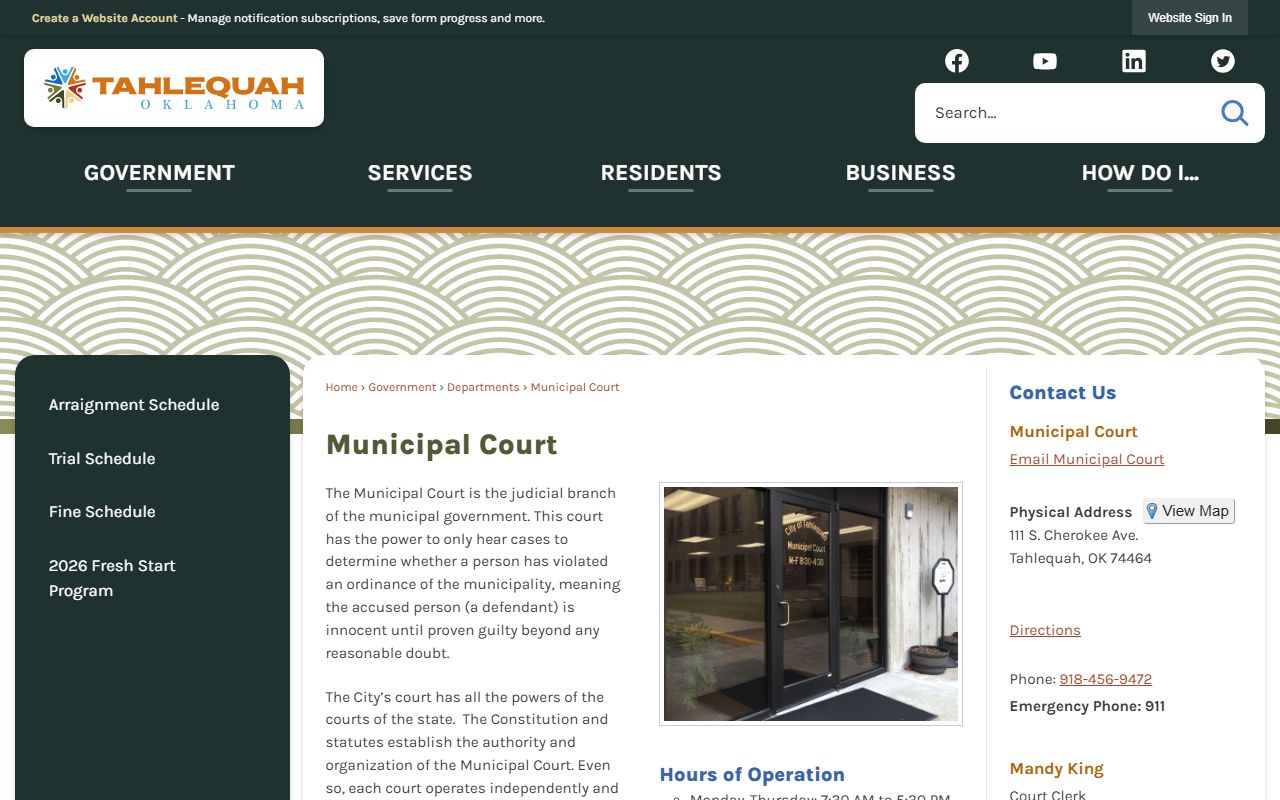
That page confirms the municipal court is a separate venue with its own clerk line at 918-456-9472, so a city warrant is resolved there rather than at the courthouse counter. Tahlequah is also the capital of the Cherokee Nation, which adds a third layer. When a matter falls under tribal jurisdiction, the case and any warrant belong to the Cherokee Nation court system, not the state court.
The Cherokee Nation Judicial Branch runs a District Court that hears civil, criminal, and juvenile matters across the reservation, with a court clerk who answers case questions by phone. You can read about its structure on the Cherokee Nation Judicial Branch site.
That branch lists its courts and contacts, and the Court Clerk there can be reached at 918-207-3900 for tribal case information. Pending tribal criminal cases are prosecuted by the Cherokee Nation Attorney General, whose office page explains its role and records process.
The Attorney General handles tribal prosecution and can be reached at 918-453-5262 for case questions. The office page is the Cherokee Nation Attorney General site.
That page confirms the tribal prosecutor as the contact for pending Cherokee Nation criminal matters, which keeps tribal warrants separate from the state district and city paths above.
What to Do If You Have an Outstanding Warrant
If a docket entry suggests an open warrant, the safest move is to confirm it before doing anything else. Do not rely only on a third-party website, and do not assume a mailed payment clears a warrant unless the court says so. Identify the issuing court first, because a felony or misdemeanor warrant routes to the District Court and District Attorney, while a city citation routes to Tahlequah Municipal Court.
- Confirm the warrant with the issuing court or the Sheriff's Office, using the Court Clerk at 918-456-0691 for state cases.
- Ask whether the warrant is active, recalled, or tied to a payment plan, and learn the bond amount and whether a personal appearance is required.
- Route by type: a municipal warrant to Tahlequah Municipal Court, a felony or misdemeanor to the District Court, District Attorney, or your attorney.
- Keep proof of any payment or court order after a warrant is recalled, in case the status needs to be shown later.
The charges behind a warrant, and how they move from filing to disposition, sit in the Cherokee County court charge records. Reading those entries helps you understand the bond and the next setting before you appear.
Important: Speak with a lawyer before turning yourself in, since counsel can ask the court to recall a warrant or arrange bond and a hearing.
Restricted Cherokee County Warrant Records
Some warrant material never appears in a public docket search. Juvenile matters are filed with the Court Clerk but kept separate and confidential, so warrants tied to those cases are not open to the public. Mental health, adoption, and guardianship files carry their own confidentiality rules under Oklahoma law and require a court order for access.
Sealed and expunged cases also drop out of public view. Oklahoma allows a full arrest-record expungement under one statute and a deferred-sentence update under another, and a granted order limits what the public docket shows. Federal warrants are a separate system entirely, handled through the U.S. District Court for the Eastern District of Oklahoma rather than the county court.
Note: Online dockets can lag or omit confidential entries, so the Court Clerk and the issuing court remain the offices that confirm whether a Cherokee County warrant is active.