
Criminal Court Records in Cherokee County
A criminal court record holds everything the District Court files once the state brings a charge. The Cherokee County Court Clerk opens the case file and keeps it current. Lesa Rousey-Daniels has served as Court Clerk since October 2018. Her office works with the District Attorney to file misdemeanors, felonies, traffic, and wildlife cases. Each filing, hearing, and order is logged on the case docket. The clerk also issues criminal warrants tied to those cases and stores both the paper and electronic file in Room 302 of the courthouse.
Cherokee County District Court is the state trial court for criminal cases. It hears both misdemeanors and felonies. A misdemeanor is a lower-level crime, and its case number starts with the prefix CM. A felony is a serious crime that can carry prison time, and its case number starts with CF. The same court handles both, but felonies move through extra steps such as a preliminary hearing. Lesser city offenses go to the Tahlequah Municipal Court instead. Broader civil and family filings sit alongside criminal matters in the county court records.
How to Search Cherokee County Criminal Court Records
The county points the public to two free online systems. On Demand Court Records, known as ODCR, hosts Cherokee County case search and online payments. The Oklahoma State Courts Network, or OSCN, is the statewide judiciary docket portal and also carries Cherokee County District Court cases. Either one can pull up a criminal case by name or number.
- Open the ODCR portal, choose Oklahoma District Courts, then select Cherokee as the court.
- Enter the defendant name in Last, First format, or type the full case number when you already know it.
- Narrow the search by case type, such as Criminal Felony Proceedings or Criminal Misdemeanor Proceedings, and add a filed-date range.
- Open the matching case to read the full docket, the counts, the pleas, and the disposition.
- Request a certified copy from the Court Clerk when you need an official document, since the online page is not the official record.
OSCN offers the same kind of lookup at its dockets page and adds daily docket reports by judge and case type. It can show a human-verification screen, so ODCR works as a reliable backup. For a statewide criminal history rather than a single case, the Oklahoma State Bureau of Investigation runs the official record check. Online dockets are convenient, but the Court Clerk holds the official file.
Note: Online dockets through ODCR and OSCN are convenient, but only the Court Clerk in Room 302 keeps the certified criminal case file that courts and agencies accept.
Stages of a Cherokee County Criminal Case
A criminal case follows a set path, and each step leaves a mark on the record. It begins when the District Attorney files charges based on a police report or an investigation. District 27 District Attorney Jack Thorp is the charging authority for Cherokee County. From there the case moves through arraignment, pretrial work, a plea or trial, and finally sentencing if there is a conviction. The docket records the date and result of every step.
The charging decision rests with the prosecutor, and the Cherokee County District Attorney's office handles that work for state crimes.
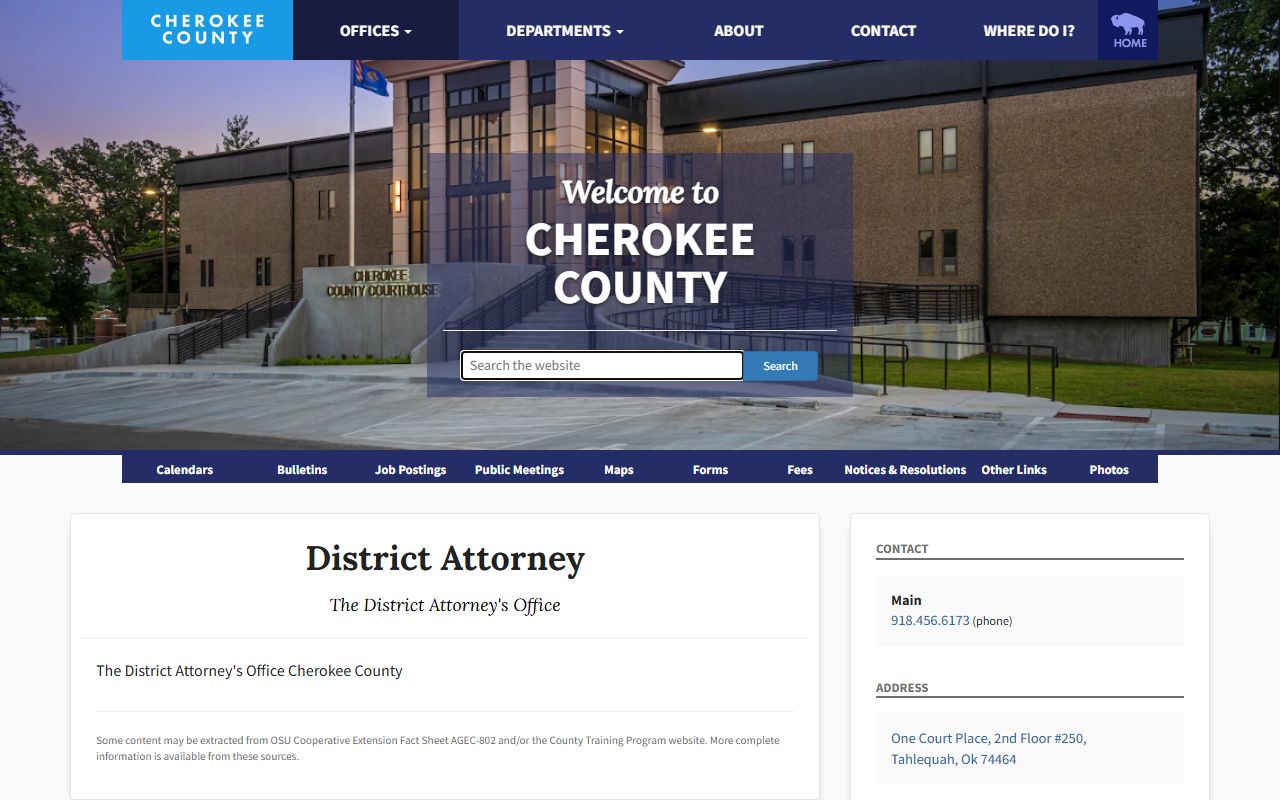
Once the office files a complaint or information, the clerk opens the case file and the court schedule begins. Each stage below adds new entries to that file.
Case flow: Charges Filed › Arraignment › Pretrial / Motions › Plea or Trial › Disposition › Sentencing
| Stage | What Happens |
|---|---|
| Charges Filed | The District Attorney files a complaint or information listing each count, and the clerk opens the case with a CF or CM number. |
| Arraignment | The defendant first appears, hears the charges, and enters a plea of guilty, not guilty, or no contest. Bond is set or reviewed. |
| Pretrial / Motions | Lawyers exchange evidence and file written requests. Felony cases include a preliminary hearing to test the evidence. |
| Plea or Trial | Most cases end with a plea. If not, a judge or jury decides guilt at trial. |
| Sentencing | After a conviction the judge imposes the penalty, which may include jail, fines, probation, or restitution. |
What a Cherokee County Criminal Court Record Shows
Every Cherokee County criminal case file is built from the same core fields. The header names the court as the District Court in and for Cherokee County, Oklahoma. Below it sits the case caption, usually styled State of Oklahoma versus the named defendant. The docket then lists each event in date order with a code, a description, the count it applies to, the party, and any dollar amount. Reading those rows tells the full story of the case.
| Field | What It Shows |
|---|---|
| Case Number | The court identifier in prefix-year-number form, such as CF for a felony or CM for a misdemeanor. |
| Case Type | The category of the case, such as Criminal Felony or Criminal Misdemeanor. |
| Defendant | The person charged, along with the district attorney, arresting officer, and arresting agency as parties. |
| Charges / Counts | Each count with its description and number, since one case can carry several charges. |
| Plea | The defendant's response to each count, such as guilty, not guilty, or no contest. |
| Disposition | The current or final result of each count, such as convicted, dismissed, or acquitted. |
| Sentence | The penalty after a conviction, plus costs, fines, and any payment plan. |
The counts section deserves a close read, because one case can carry several charges that each end differently. A deeper breakdown of how those charges get filed and changed appears in the county arrest records and court charges.
Reading Dispositions in Cherokee County Records
The disposition is the bottom line of a criminal record. It states how each count ended. Common entries include guilty, not guilty, dismissed, and nolo contendere, which means no contest. A deferred sentence is common in Oklahoma and delays final judgment while the defendant meets court terms. The sentence follows a conviction and spells out the penalty, from fines to probation to jail time.
- Disposition
- The result of a charge, such as a conviction, a dismissal, or an acquittal.
- Deferred sentence
- A delay in final judgment that can lead to dismissal if the defendant meets the court's conditions.
- Nolo contendere
- A no-contest plea that accepts the judgment without fully admitting the facts.
- Probation
- Court supervision served in the community instead of or after jail.
- Restitution
- Money the court orders a defendant to pay a victim.
A dismissed count and a deferred count read differently in the file, so it pays to check each one.
Charges vs. Convictions
Being charged is not the same as being convicted. A criminal court record can show charges that were dropped, dismissed, or that ended in acquittal. A charge is an accusation that the prosecutor files. A conviction is the finding of guilt that follows a plea or a trial. Reading only the charge and stopping there gives a false picture of the outcome.
| Charge | Conviction | |
|---|---|---|
| Stage | Accusation | Verdict or plea |
| Who Decides | District attorney | Judge or jury |
| Burden of Proof | Probable cause | Beyond reasonable doubt |
| Public Record | Yes | Yes |
Public Access to Cherokee County Criminal Court Records
Oklahoma law treats most criminal court records as open. The Open Records Act lets the public inspect and copy records of public bodies during business hours unless a record is confidential or exempt. The Court Clerk follows that rule for criminal case files. Online docket pages help, but they warn that the report is not the official record and must be verified with the official record keeper.
Key Statutes:
Oklahoma Statutes 51 O.S. § 24A.5 - records of public bodies are open for inspection and copying unless a law makes them confidential.
Oklahoma Statutes 51 O.S. § 24A.6 - public bodies must post the regular business hours when records can be inspected and copied.
Sealed vs. Expunged Records
Two different tools can limit access to a Cherokee County criminal record, and they are not the same. Sealing hides a record from public view while it still exists. Expungement goes further and can erase the arrest record itself. Oklahoma splits expungement into two statutes that often get confused.
The Oklahoma State Bureau of Investigation explains both paths on its criminal history expungement page.
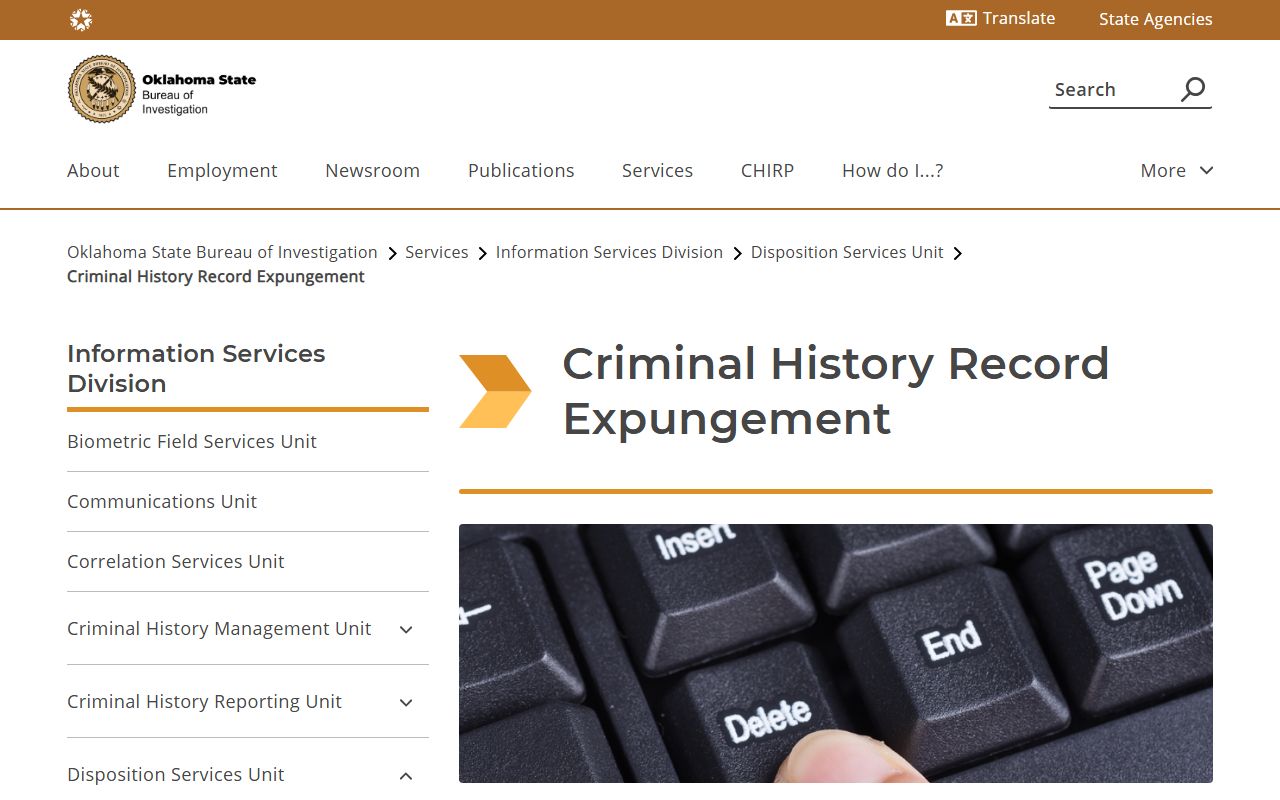
Section 18 of Title 22 can expunge an entire arrest record when a person qualifies. Section 991(c) only changes a deferred-sentence disposition to show the case was dismissed after a plea is withdrawn, and it leaves the arrest record in place. The two reach very different results.
| Sealed | Expunged | |
|---|---|---|
| Visibility | Hidden from public view | Removed from the public record |
| Law Enforcement | Limited access remains | Very limited access |
| Oklahoma Statute | 22 O.S. § 991(c) deferred-sentence update | 22 O.S. § 18 full arrest-record expungement |
| Arrest Record | Stays on file | Can be expunged when eligible |
Note: A 991(c) expungement updates the court disposition but does not remove the underlying arrest record, so a separate Section 18 petition may still be needed.
Tribal and Federal Criminal Court Jurisdiction
Cherokee County sits in a layered jurisdiction, so not every criminal case lands in state District Court. Tahlequah is the capital of the Cherokee Nation, and the Cherokee Nation District Court hears civil, criminal, and juvenile matters within tribal jurisdiction. Those cases are filed and searched through the tribal court, not the county Court Clerk.
Federal crimes are handled in the U.S. District Court for the Eastern District of Oklahoma. The U.S. Attorney's office notes that the Eastern District is entirely Indian country, which shapes how many local offenses get routed. Federal case files are searched through PACER, not the county portals. Checking the right venue matters before deciding a case is missing.
Restricted Cherokee County Criminal Court Records
Some Cherokee County criminal court records never reach public search. Juvenile cases are confidential under Oklahoma's juvenile code, found in Title 10A, and stay closed except to authorized people. Sealed and expunged cases drop out of public view by court order. The clerk also keeps certain filings separate when a statute requires it. An open investigation may hold parts of a file out of reach until the case resolves. When a search comes up empty, the record may exist but be restricted rather than missing.
Defense and Prosecution in Cherokee County
Two offices shape most Cherokee County criminal cases. District 27 District Attorney Jack Thorp prosecutes state crimes for the county and decides what charges to file. Defendants who cannot afford a lawyer may receive a court-appointed attorney. Both sides generate filings that appear on the case docket and become part of the record.
Court-appointed defense in the county runs through the Oklahoma Indigent Defense System coverage page for Cherokee County.
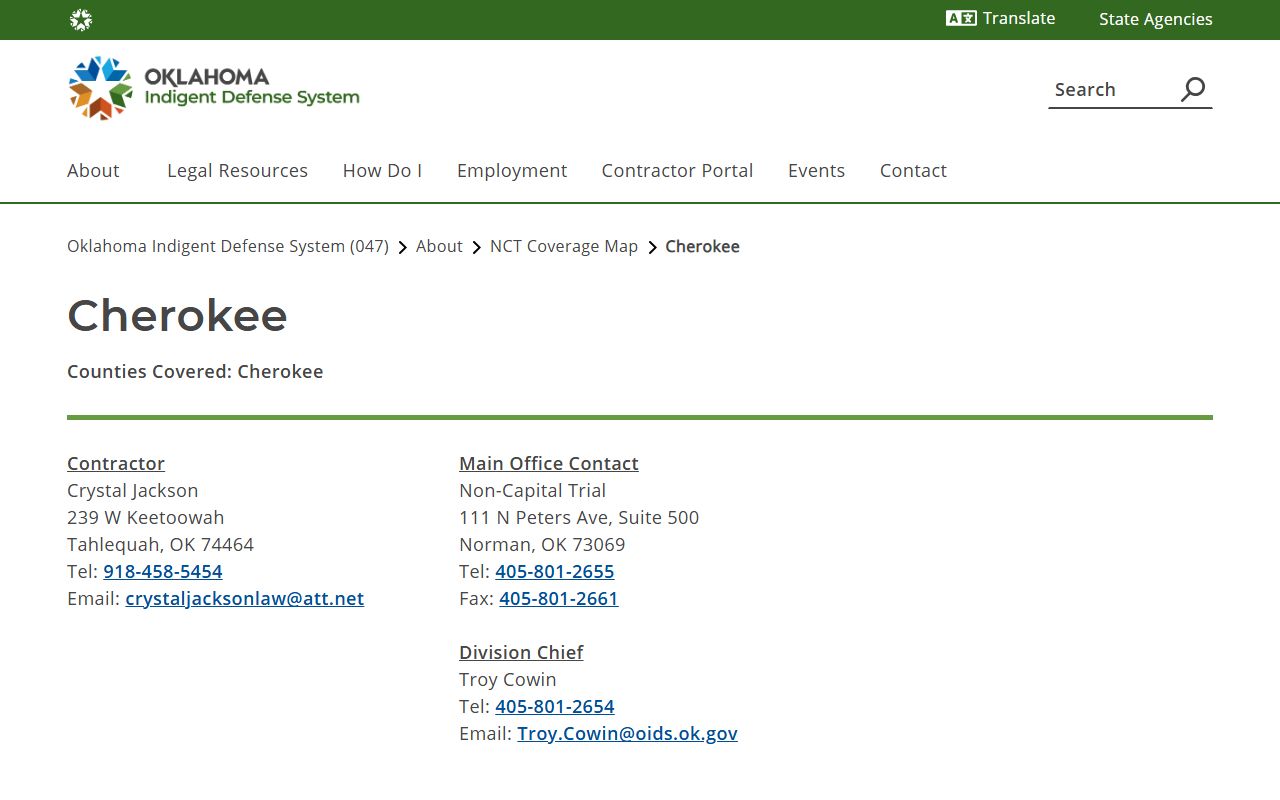
That page lists Crystal Jackson as the local contract attorney for indigent defense in Tahlequah. Knowing who prosecutes and who defends a case helps explain the motions, hearings, and outcomes that show up in the criminal court record.