
Cherokee County Arrest Records and Court Charges
A Cherokee County arrest record is the account of an arrest itself. It names who was taken into custody, which agency made the arrest, and when booking took place. The arrest does not decide guilt. It only puts a person into the system. From there the District Attorney reviews the facts and chooses whether to file formal charges. When charges are filed with the Court Clerk, they open a court case and become the charge record. The Court Clerk works with the District Attorney to file misdemeanors, felonies, traffic, and wildlife matters in Cherokee County District Court.
The two records live in different places. The arrest and booking side sits with the jail, and the day-to-day custody detail belongs on the Cherokee County inmate records page. The court charges after arrest sit with the District Court, tracked count by count through the case. One arrest can lead to several charges, fewer charges, or none at all, because the prosecutor controls what gets filed. The full case file, with pleas, dispositions, and sentencing, is covered on the Cherokee County criminal court records page.
How to Find Cherokee County Arrest Records and Charges
Charges and their status show up in the online court case search, not in a booking blotter. Cherokee County points the public to two systems. The Court Clerk links case searches to On Demand Court Records, known as ODCR. The Oklahoma State Courts Network, or OSCN, runs the statewide docket search and lists Cherokee County District Court in its court menu. Both are free, and both show the charge side rather than the booking side.
- Open the ODCR search and pick Oklahoma District Courts as the court group, then choose Cherokee from the court list.
- Search by defendant name in Last, First order, or enter the full case number when you know it.
- Open the matching case to read the count list and the charge filed against each defendant.
- Check each charge for its code, its level, and its current status in the docket.
When a name search returns too many results, the filed-date and activity-date filters narrow it. OSCN may show a human-verification screen, so ODCR is the steady backup. Online dockets are convenient, but they carry a warning that the page is not the official record. Verify any charge with the Court Clerk in Room 302 at 918-456-0691 before relying on it.
How Cherokee County Charges Get Filed After an Arrest
The charge record begins when a charging document is filed. In Oklahoma the District Attorney is the charging authority for state crimes, and that office decides what gets filed after an arrest. For Cherokee County the prosecutor is District 27, led by District Attorney Jack Thorp, whose Cherokee office can be reached at 918-456-6173. Three charging documents can start a criminal case, and which one is used depends on the offense.
| Complaint | Information | Indictment | |
|---|---|---|---|
| Filed By | Officer / Prosecutor | Prosecutor | Grand Jury |
| Common For | Misdemeanors | Many felonies | Serious felonies |
| Starts | The case | The case | The case |
Most Cherokee County felonies move forward on an Information after a preliminary hearing, where a judge decides there is enough evidence to bind the case over for trial. A grand jury Indictment is less common and is reserved for serious matters. The District Attorney, not the arresting officer, distinguishes a raw arrest record from a filed court charge. Not every charge stays in state court either, because Tahlequah sits inside the Cherokee Nation Reservation.
The U.S. Attorney's Office for the Eastern District of Oklahoma confirms that Cherokee County falls within its district, which it describes as entirely Indian country.
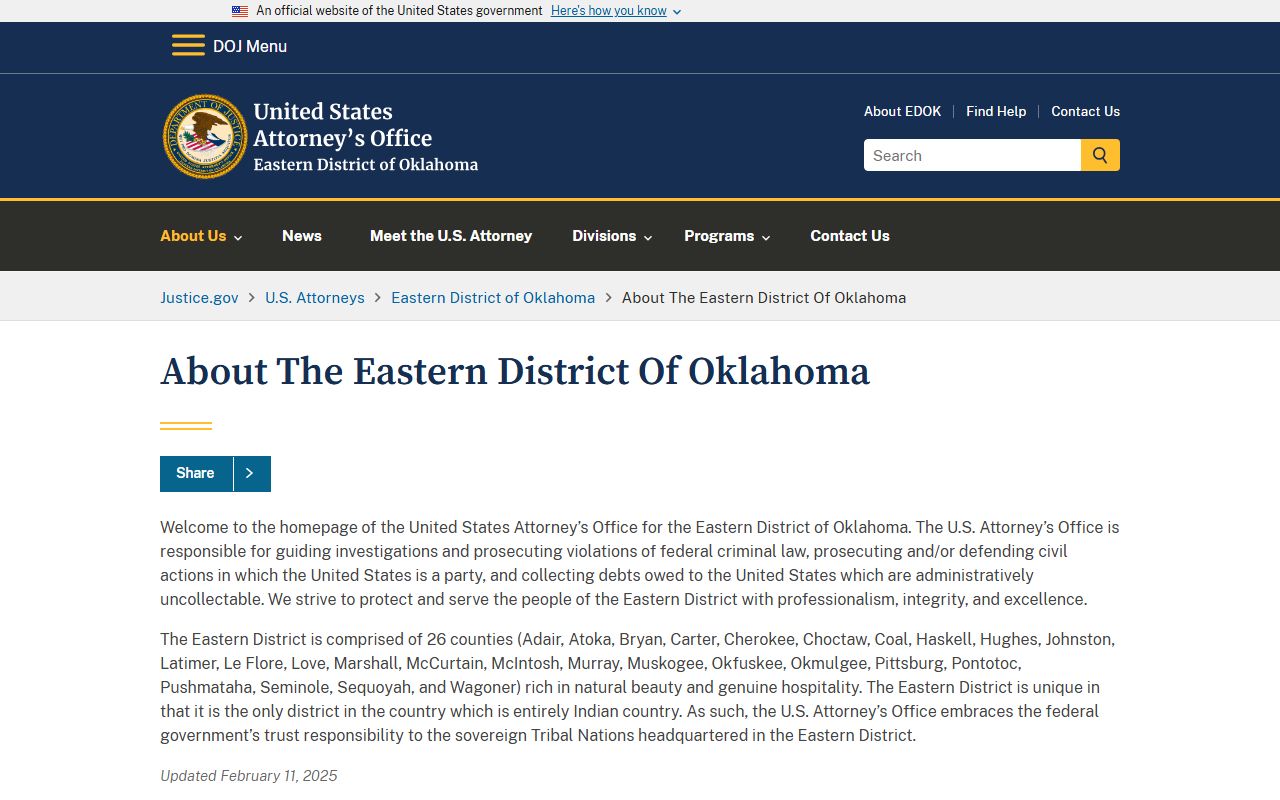
That overlap means an arrest in the county can lead to state charges from the District Attorney, federal charges from the Eastern District, or tribal charges in Cherokee Nation District Court, depending on where jurisdiction belongs.
Cherokee County Charge Codes and Case Prefixes
Every charge ties back to a section of Oklahoma statute, and the case number itself signals the charge level. Cherokee County uses letter prefixes that appear in ODCR and OSCN results. A felony case carries the CF prefix, a misdemeanor case carries CM, and a traffic case carries TR. The format runs prefix, year, and number, such as TR-2024-00345. A single arrest can produce several separate counts, and those counts may sit at different levels within the same case.
Common Cherokee County case prefixes include:
- CF for felony cases
- CM for misdemeanor cases
- TR for traffic cases
- PO for protective orders
- SW for search warrants
The prefix is a fast way to gauge how serious a charge is before reading the full docket. A felony and a misdemeanor stemming from the same arrest will open under different case numbers.
Cherokee County Charge Status and What It Means
Charges are not fixed once filed. As a case moves, a prosecutor can amend a charge, reduce it, add a count, or drop it. The docket records each change with a date and a code. Reading the current status matters, because an early charge may look very different by the time the case closes.
| Status | What It Means |
|---|---|
| Filed | The charge has been entered and the court case is now open. |
| Pending | The charge is active and awaiting a plea, hearing, or trial result. |
| Amended / Reduced | The prosecutor changed the charge, often to a lower level. |
| Bound Over | A judge found enough evidence to send a felony charge forward for trial. |
| Dismissed | The court ended the charge, with or without the right to refile. |
| Nolle Prosequi | The prosecutor formally declined to pursue the charge. |
Note: A dismissed or declined charge can still appear in the public case file unless it is later sealed or expunged under Oklahoma law.
Charges vs. Convictions
A charge is an accusation. A conviction is the result reached after a plea or a trial. The two carry very different weight, yet both can appear in a public case file. A person may be charged and later have the charge dropped, reduced, or beaten at trial, and that history stays visible in the docket.
| Charge | Conviction | |
|---|---|---|
| Stage | Accusation | Verdict or plea |
| Burden of Proof | Probable cause | Beyond reasonable doubt |
| Outcome | Not yet decided | Guilt established |
| Public Record | Yes | Yes |
Statewide Charge and Criminal History Lookups
Local case searches show one county at a time. A full criminal history pulls charges from across Oklahoma. The Oklahoma State Bureau of Investigation, or OSBI, maintains the statewide criminal history repository and handles record checks for a fee. For people sent to state prison, the Oklahoma Department of Corrections offender lookup tracks custody and sentence basics, though it notes the data is abbreviated. Oklahoma VINE provides custody and case notifications statewide.
The Cherokee County Sheriff's page also links the Oklahoma Sex and Violent Offender Registry, a separate statewide list for registered offenders. It is not a charge search, but it is part of the wider public-record picture for certain serious convictions. None of these state tools replace the county case file, which remains the source for the exact counts filed after an arrest.
Sealed and Expunged Charge Records
Sealing and expungement are not the same, and Oklahoma treats them through two different statutes. A Section 18 expungement, under 22 O.S. Section 18, can clear an entire arrest record when a person meets the eligibility rules. A Section 991(c) expungement, under 22 O.S. Section 991(c), applies to a deferred sentence. It updates the disposition to show the case was dismissed, but it does not remove the underlying arrest record. The OSBI expungement page explains both routes.
| Sealed | Expunged | |
|---|---|---|
| Visibility | Hidden from public | Treated as never existed |
| Law Enforcement | Limited access | Very limited |
| Oklahoma Route | Court order under state law | 22 O.S. Section 18 or 991(c) |
Cherokee County Jail Booking Information Limits
Booking information has real limits in Cherokee County, and the reason is local. Unlike most Oklahoma sheriffs, the Cherokee County Sheriff does not run the county jail. The Cherokee County Detention Center is a trust authority with its own County Jail Board, and the sheriff sits on that board without controlling daily operations. The sheriff's office still handles patrol, investigations, courthouse security, prisoner transport, and civil process.
The Cherokee County Sheriff's official page sets out these duties and the jail-governance split.
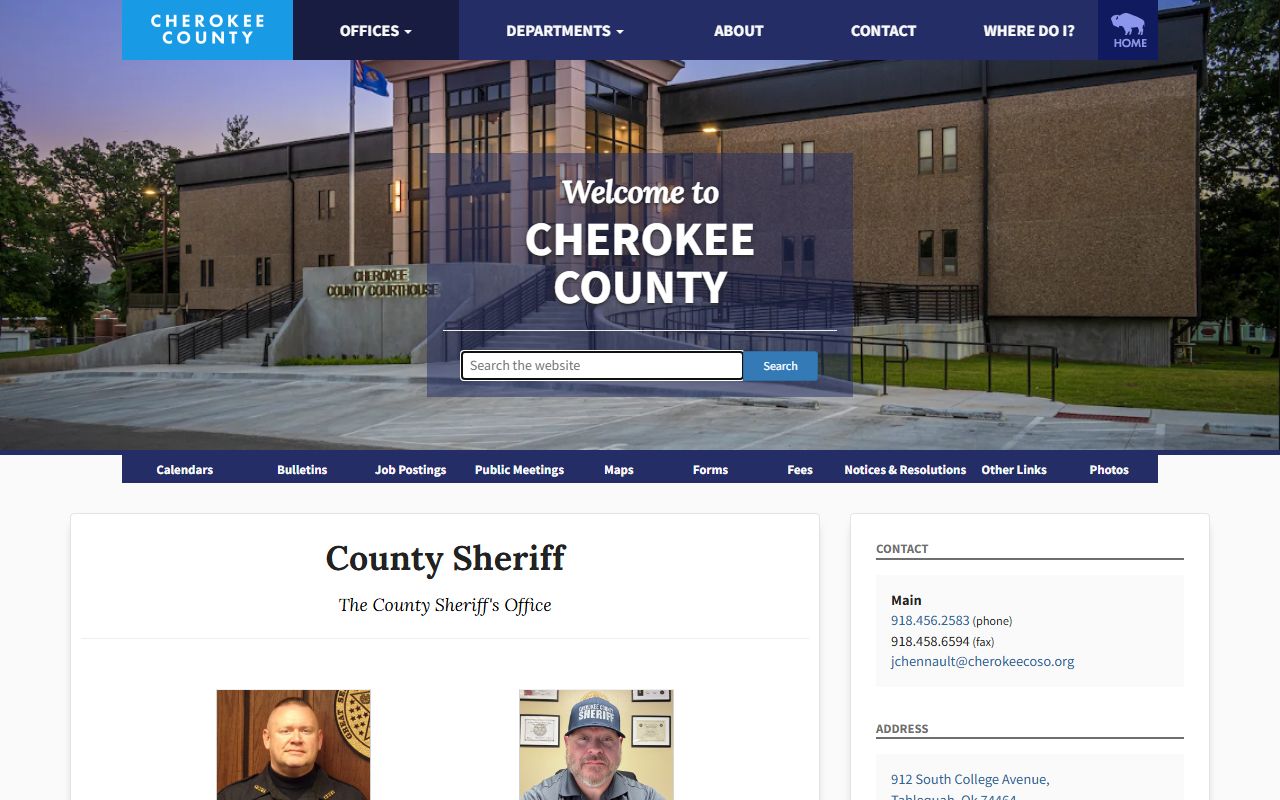
Because the jail is run by a separate trust, custody status and booking detail are confirmed through the Detention Center rather than pulled from a sheriff-run roster. The charge record on the court side stays the more complete source for what a person actually faces after an arrest.
Background Check Considerations
Charge records often feed into background checks, but there is a line between a formal check and a casual lookup. An employer, landlord, or licensing body that runs a regulated background check must follow the federal Fair Credit Reporting Act. A quick name search on a court portal does not meet that standard.
Important: Cherokee County arrest and charge records are public records, not a consumer report under the FCRA, and the information cannot be used to decide employment, housing, credit, or insurance.
Restricted Charge Records in Cherokee County
Not every charge is open to the public. Oklahoma keeps juvenile matters confidential, and the Court Clerk files adoption, guardianship, and mental health cases separately because they are not public. Sealed and expunged charges drop out of public view as well, and an ongoing matter may show limited detail until it is resolved.
Dismissed and declined charges can sometimes be cleared through expungement. A person should first confirm whether the issue is the arrest record itself or only a deferred-sentence disposition, then petition the District Court. The Court Clerk and OSBI confirm current eligibility and filing costs, since those figures are not published on the county's local page.